My AI Coach Doesn't Sleep: A Data-Driven Health Transformation
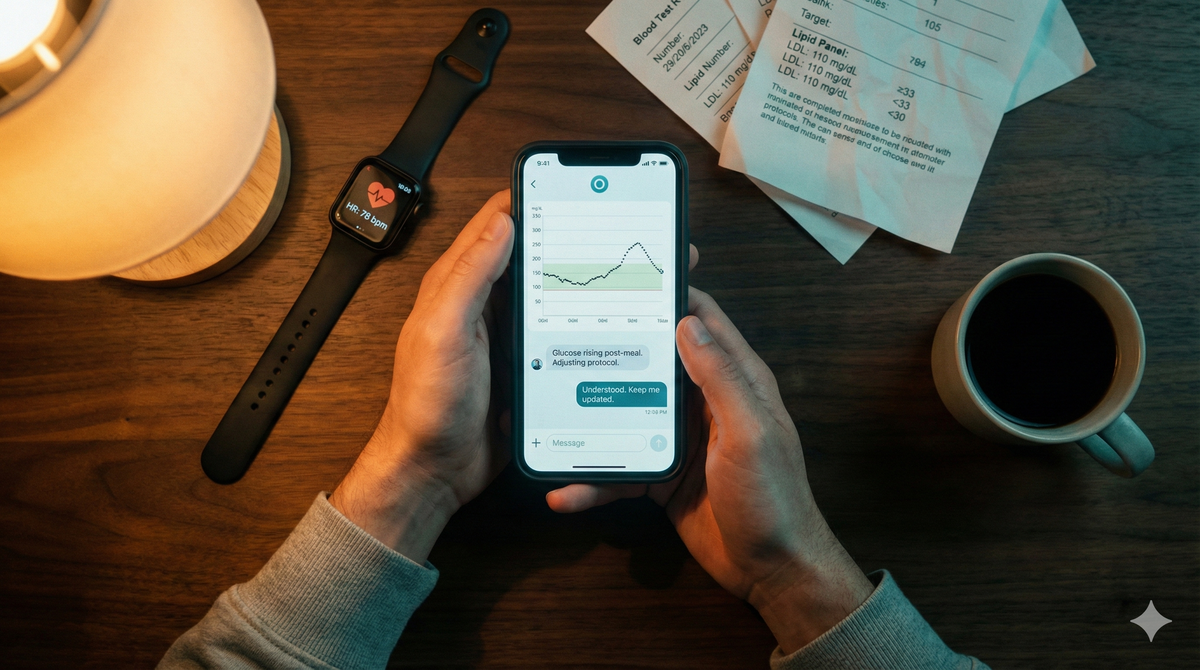
How AI Coached Me Through a Metabolic Transformation
Six months, hundreds of conversations, thousands of data points. What happens when an engineer uses large language models as a daily metabolic health coach — and why this changes everything.
In my origin story, I described reversing metabolic syndrome at 59 without medication — pre-diabetes, Stage 2 hypertension, severe sleep apnea, all normalized through a simultaneous intervention across diet, exercise, and sleep.
What I didn't fully explain was how I navigated the complexity. How I interpreted thousands of glucose readings. How I made sense of monthly lipid panels that sometimes contradicted each other. How I adjusted exercise protocols in real time. How I dealt with the psychological weight of transforming every aspect of my daily life at once.
The answer is that I had a coach available 24 hours a day, 7 days a week, who never got tired, never forgot my history, and could reason across biochemistry, exercise physiology, psychology, and data analysis simultaneously.
That coach was an AI. Specifically, Claude — Anthropic's large language model.
This is the story of what AI-coached health optimization actually looks like in practice, drawn from hundreds of real conversations over six months. Not theory. Not marketing. The raw, messy, sometimes embarrassing reality of a 59-year-old engineer arguing with an AI about dumplings at 11pm in Seoul.
What AI Coaching Actually Looks Like
Most people interact with AI by asking a question and getting an answer. That's a search engine with better grammar. What I did was fundamentally different: I built an ongoing relationship with an analytical partner, feeding it continuous streams of biomarker data and receiving real-time interpretation and guidance.
Here's the pattern that repeated hundreds of times:
I would upload a CGM screenshot. A photo of my continuous glucose monitor's trace — that squiggly line showing my blood glucose over the past few hours. I'd describe what I ate, when I ate it, what I was doing.
Within seconds, the AI would interpret the trace. Not just "your glucose went up" — it would identify the likely cause, explain the metabolic mechanism, compare it to my previous responses, and suggest adjustments.
One morning in Seoul, I had what I thought was a perfectly ketogenic breakfast: bacon, eggs, sausages, mozzarella, mushrooms, broccoli, kimchi. My CGM showed a flat, beautiful response — metabolic bliss. Then a small spike appeared about 90 minutes later.
I'd forgotten about one small dumpling I'd eaten alongside breakfast.
The AI caught it immediately. But what made the analysis valuable wasn't just identifying the dumpling — it was explaining why the spike was delayed. All the fat and protein from the rest of the breakfast had slowed gastric emptying, trapping the dumpling's refined carbohydrates in my stomach. Instead of hitting my bloodstream in 30 minutes (as it would have on an empty stomach), the glucose appeared 90 minutes later, blunted and delayed.
That's not information I would have found on a web search. That's a real-time physiological lesson, personalized to my exact meal, my exact metabolic state, delivered at the moment I needed it.
This happened daily. Sometimes multiple times a day.
The Experiments Nobody Else Would Run With Me
The most powerful aspect of AI coaching wasn't the individual answers — it was the willingness to follow me down every rabbit hole, no matter how granular.
The egg experiment. I was eating four eggs a day on my ketogenic diet. My September lipid panel showed LDL had spiked to 191 mg/dL. The AI and I designed a controlled elimination: remove eggs completely, retest in four weeks. October results came back — LDL had dropped to 128 mg/dL. A 63-point swing.
I was a dietary cholesterol hyper-responder. About 25-30% of people are, but most never discover it because they never run the experiment. My AI coach helped me design the protocol, interpret the results, and then plan a careful reintroduction strategy — testing moderate egg intake to find my personal tolerance threshold.
A human nutritionist might have eventually gotten there. But the iterative, data-rich conversation — uploading each lipid panel, discussing the biochemistry of cholesterol absorption, debating whether ApoB particle count mattered more than raw LDL numbers — would have required dozens of appointments at hundreds of dollars each. Instead, it happened across a few evening conversations from my living room.
The protein-induced glucose response. One afternoon, I ate sous vide salmon, Mediterranean vegetables, and a tiny amount of rice. My CGM showed a 3 mmol/L excursion despite minimal carbohydrates. I was confused.
The AI walked me through gluconeogenesis — how my keto-adapted liver was converting amino acids from the protein bolus into glucose. It explained why the curve was rounded and gradual (characteristic of protein-mediated glucose production) rather than sharp and fast (characteristic of carbohydrate). It noted that my fasted state before the meal had likely upregulated hepatic glucose output, making me more responsive to the protein load.
I didn't know the word "gluconeogenesis" when the conversation started. By the end, I understood not just what happened, but why my body did it, and how to modulate the response in future meals.
The Accountability That Data Creates
One of the most underappreciated aspects of AI coaching is accountability through data transparency. When you share your CGM trace with an AI, there's nowhere to hide.
During my family trip to Seoul, I was testing how Korean food affected my glucose control. I ate samgyetang (ginseng chicken soup with rice) and watched my glucose spike to 6.8 mmol/L. The AI analyzed the response and noted I'd need to walk to clear it. I went shopping for an hour — the post-meal trace came down beautifully.
That same trip, a bowl of wonton soup pushed me past 10 mmol/L. The AI documented it matter-of-factly: wonton wrappers are refined flour, the soup format accelerates gastric emptying, this was a predictable outcome. No judgment. Just data, mechanism, and a note about which Korean foods would be better metabolic bets next time (Korean BBQ with lettuce wraps, kimchi-jjigae without rice, soft tofu stew).
The AI didn't need to scold me. The data did that on its own. But having a coach who would systematically analyze every meal response — good and bad — created a feedback loop that was relentless in the best way. I couldn't pretend the wonton soup was fine. The trace was right there.
Over weeks, this feedback loop rewired my decision-making. Not through willpower or guilt, but through understanding. When you see the mechanism — when you understand at a biochemical level why that dumpling created a 90-minute delayed spike — you don't need motivation to avoid it. You have knowledge. And knowledge, it turns out, is far more durable than discipline.
Beyond Glucose: The AI as Integrative Analyst
The conversations went far beyond glucose management. The AI became a general-purpose health analyst, connecting dots across domains that no single specialist would typically integrate.
Cardiovascular risk stratification. When my coronary artery calcium score came back at 7 (minimal), the AI helped me contextualize it against my lipid history, my Lp(a) levels, my family history, and my whole genome sequencing results. It mapped out scenarios: if my polygenic risk score came back low, skip the CT angiogram; if moderate-to-high, get one. It explained pharmacogenomic implications — what certain gene variants meant for statin tolerability if I ever needed one.
No single doctor in my care team had synthesized all of these data points into one coherent risk picture. The AI did it in a single conversation.
Exercise programming. When I went from zero chin-ups to three bodyweight chin-ups in four weeks, the AI explained why progress had been rapid (neuromuscular adaptation — my nervous system relearning a movement pattern from my 40s) and why it would now plateau (actual muscle hypertrophy is slower). It prescribed cluster sets, negative reps, and grip variation. When I hit lifetime personal records on overhead press — stronger at 59 than at 47 — the AI recalculated my entire chin-up progression timeline.
The inflammation mystery. This one took weeks to unravel — and it's a perfect example of how iterative AI dialogue can solve problems that a single doctor's visit cannot.
Four months into my transformation, my metabolic markers were excellent. Glucose: controlled. Blood pressure: normalized. Lipids: transformed. But two stubborn numbers refused to cooperate: my hsCRP (a marker of systemic inflammation) was 5.7 mg/L — well above the ideal of under 1.0 — and my GGT (a liver enzyme) was significantly elevated.
This was confusing. I was doing everything right. The AI and I spent multiple conversations working through the differential diagnosis. Was it dietary? We analyzed my food logs — unlikely on a clean ketogenic diet. Was it the exercise? Overtraining can elevate inflammatory markers, but my training load was moderate. Was it an undiagnosed infection? Possible, but nothing else pointed that way.
Then, across several conversations where we kept circling back to the timeline, a pattern emerged. The AI noted that my tonsillectomy had been major surgery involving significant tissue trauma, and that post-surgical inflammation can persist for months — far longer than most people realize. More importantly, it connected the dots to a deeper issue: I had lived with severe obstructive sleep apnea for likely a decade before the surgery. An oxygen desaturation index of 38.5 events per hour meant my body had endured years of chronic intermittent hypoxia — repeated oxygen drops, every night, for years.
The cumulative damage from that was substantial: chronic vascular inflammation, oxidative stress to the liver, systemic inflammatory signaling that doesn't simply switch off the day surgery resolves the obstruction. The AI mapped out an expected healing trajectory — hsCRP and GGT would decline gradually over 6-12 months as the body repaired the accumulated damage, accelerated by weight loss, improved sleep, and the anti-inflammatory effects of the ketogenic diet.
This reframing changed everything. Instead of anxiously chasing an unknown cause, I understood that the elevated markers were expected residual damage on a healing trajectory. Each subsequent monthly test confirmed the trend — slowly declining, exactly as predicted. Without that multi-conversation investigative process, I might have pursued unnecessary testing or, worse, abandoned the protocol thinking it wasn't working.
The Self-Deception Mirror
Perhaps the most valuable role the AI played was reflecting my own self-deception back at me.
In my origin story, I described the seven months between my diagnosis and my transformation as a period of "comfortable optimization" — doing intermittent fasting, taking supplements, wearing a CGM, reading research — while avoiding the hard interventions that would have actually moved the needle.
The AI was instrumental in exposing this pattern. When I would report a glucose spike after eating rice and say "but I'm doing IF, so overall I'm fine," the AI would pull up the cumulative data: eight hours above 7.8 mmol/L per day, a fasting glucose drifting above 6.5 every night, an HbA1c heading in the wrong direction.
There's a particular kind of honesty that emerges when your data is analyzed by something that has no social anxiety about telling you uncomfortable truths. A human coach might soften the message. A doctor with ten minutes in an appointment might not dig deep enough to see the pattern. The AI simply laid out the numbers and asked the obvious question: "You're tracking this data. What are you planning to do differently based on what it's showing you?"
It also pushed back on my occasional over-optimism. Early in my recovery from the tonsillectomy, when I was rapidly losing weight, the AI got enthusiastic about my trajectory. I had to correct it: "It's only one day man! You're too optimistic!" That exchange became a useful calibration — a reminder that the coaching relationship works both ways, and that the human's judgment and skepticism are essential components of the system.
What Most People Get Wrong About AI
There's a narrative — especially in Singapore's professional circles — that AI is either going to take our jobs or that it's a fancy chatbot that generates plausible-sounding nonsense. Both framings miss what's actually happening.
AI didn't transform my metabolism. I transformed my metabolism. The AI was an analytical partner that made the complexity manageable. It reduced the friction between having data and understanding data. It compressed what would have been months of research and dozens of specialist appointments into daily, iterative, context-rich dialogue.
This is the part that most people don't grasp: the value isn't in any single answer. It's in the accumulation of hundreds of conversations, each building on the last, each incorporating new data, each refining the model of what works for my specific body.
Two years ago, this wasn't possible. I would have faced the same data — the same CGM traces, the same lipid panels, the same confusing contradictions — but without the means to interpret them at the pace and depth required. I would have Googled "high LDL on keto" and gotten ten contradictory articles. I would have stared at a glucose spike and wondered if it was the protein or the rice. I would have given up in frustration, accepted the metformin prescription, and moved on.
Instead, I had a conversation.
The Multiplier Effect
What struck me most, looking back over six months of conversations, is the compounding nature of the learning. Each conversation wasn't isolated — it was a layer added to an increasingly sophisticated understanding of my own physiology.
By month three, I could look at a CGM trace and predict what the AI would say. By month four, I was anticipating my lipid panel results based on dietary changes I'd made. By month five, I was designing my own experiments — the egg elimination protocol, the protein-glucose response tests, the exercise timing experiments — using the analytical framework the AI had taught me.
The AI didn't create dependency. It created capability. The goal of any good coach is to make themselves unnecessary. The AI was doing exactly that — each conversation made me a better interpreter of my own data, a more sophisticated experimenter, a more informed patient when I sat across from my doctor.
This is what got me thinking about a side project I've been tinkering with in my spare time — an AI-assisted health coaching tool. Not a replacement for human judgment, but an amplifier of it. A system that can sit with you at 11pm when you're staring at a confusing glucose trace, help you understand what your body is telling you, and support you in making the next decision. It's early days and very much a hobby, but the experience of being coached by AI has convinced me that this kind of tool should exist for everyone, not just engineers who happen to know how to prompt an LLM.
Because the transformation isn't in the technology. It's in the conversation.
For the Skeptics
If you're a busy executive reading this and thinking "I don't have time for hundreds of AI conversations about my blood sugar" — I understand. I'm a Head of Technology Risk at a major bank. I work long hours. I have a family.
But consider this: you're already spending time on your health. Doctor's appointments that leave you with more questions than answers. Googling symptoms at midnight. Trying diets that work for someone else's body but not yours. Buying supplements based on podcast recommendations without knowing if they're doing anything.
The question isn't whether you have time for AI-coached health optimization. The question is whether you can afford to keep navigating your metabolic health without it.
I couldn't. And the data is unambiguous about the result.
This is the second post in the Metabola origin series. The first, "Why I Started a Metabolic Health Lab at 59", covers the transformation itself. Metabola is a metabolic health laboratory for the curious — if you want to approach your health with the rigor of an engineering challenge, subscribe to the lab.
Koon Seng is a technology risk leader, Precision Nutrition L1 certified coach, and author of "The 10,000 Year Detour." He lives in Singapore, where he continues to argue with AI about dumplings.